http://www.ibls.com/internet_law_news_portal_view.aspx?s=sa&id=1102
I copy the following context from Patently-O blog.
Internal documents:Internal documents intended to be confidential are not "printed publications" and are unavailable for use as prior art. This is regardless of how many copies are distributed. Additionally, note that "[w]hile distribution to government agencies and personnel alone may not constitute publication...distribution to commercial companies without restriction on use clearly does." Garrett v. US., 422 F.2d 874 (Ct. Cl. 1970).
Electronic Publications:An electronic publication, including an on-line database or Internet publication, is considered to be a "printed publication" within the meaning of 35 U.S.C. § 102(a) and (b) provided the publication was accessible to persons concerned with the art to which the document relates. Thus, "whether information is printed, handwritten, or on microfilm or magnetic disk or tape, etc., the individual who wishes to characterize the information as a printed publication...should produce sufficient evidence of its dissemination or that it has been otherwise available and accessible to persons concerned with the art to which the document relates..." Wyer, 655 F.2d 227, Amazon.com v. Barnesandnoble.com, 73 F. Supp. 2d 1228 ( W.D. Wash. 1999).
Web Pages Must Be Static:Prior art disclosures on the Internet or in an on-line database are considered to be publicly available as of the date the item was publicly posted. This is provided that the item is dated and not temporal, and can be indexed for subsequent retrieval. An example of a temporal item is a web broadcast that cannot be saved, retrieved or printed, e.g., a live simulcast feed that is not archived, and a "streaming" audio or video that "flashes" across the screen.
Tuesday, January 22, 2008

Quanta v. LG
One of the cases pending in the U.S. Supreme Court is Quanta v. LG, which deals with important legal doctrines in the patent law - Patent Exhaustion (the first use doctrine) and Implied License.
http://www.aipla.org/Template.cfm?Section=20084&Template=/ContentManagement/ContentDisplay.cfm&ContentID=17026
I might write an article about those two doctrines because they were practically important to me.
http://www.aipla.org/Template.cfm?Section=20084&Template=/ContentManagement/ContentDisplay.cfm&ContentID=17026
I might write an article about those two doctrines because they were practically important to me.
Friday, January 18, 2008
Tuesday, January 15, 2008
New semester starts today !!!
It's bittersweet moment. Today is the first day of new Spring semester.
Partly, it's great, but it's sad.
Well, I know that this is the way it has to be.
Partly, it's great, but it's sad.
Well, I know that this is the way it has to be.
Tuesday, July 10, 2007
How to think like lawyer
http://nationaljurist.com/filedownload.aspx?f=ScNLx4P8XyYD+BX9RN+kOg==
An article from National Jurist. I like this stuff.
An article from National Jurist. I like this stuff.
Tuesday, February 06, 2007
Monday, January 22, 2007
Wednesday, January 17, 2007
Links for Constitutional Law
Finally, the second semester begins.
Here are the links that the professor of Constitutional law recommend;
http://www.supremecourtus.gov/
http://supct.law.cornell.edu/supct/index.html
http://docket.medill.northwestern.edu/
http://findlaw.com/casecode/supreme.html
http://scotusblog.com/
Here are the links that the professor of Constitutional law recommend;
http://www.supremecourtus.gov/
http://supct.law.cornell.edu/supct/index.html
http://docket.medill.northwestern.edu/
http://findlaw.com/casecode/supreme.html
http://scotusblog.com/
Saturday, January 06, 2007
Licensed component requires patent exhaustion or implied license for the combination?
Note - I received this e-mail from JH Kim, a patent lawyer of my former company. This is his material, not mine. I just translated his e-mail into English.
Question) Company A has a patent about Baseband modem chip and another patent that has the same elements as previous one and an additional element of antenna. The latter patent claims cellular phones. Company A gave a license of the first patent to licensees, but it did not give a license of the second patent to licensees. Then, company A can claim royalty of the second patent against licensees?
Answer) Probably not. Because baseband chip is only used for cellular phone. Implied license and patent exhaustion may apply, unless an express disclaimer exists. See LG Electronicsm, Inc. v. Bizxom electronics, Inc., 453 F.3f 1354 (Fed. Cir. 2006)
LG Electronicsm, Inc. v. Bizxom electronics, Inc., 453 F.3f 1354.
* “To prevail, defendants were required to establish that the products have no noninfringing uses and that the circumstances of the sale ··· ‘plainly indicate that the grant of a license should be inferred.’ . . . Regardless of any noninfringing uses, Intel expressly informed them that Intel's license agreement with LGE did not extend to any of defendants' products made by combining an Intel product with non-Intel products. In light of this express disclaimer, no license can be implied.”
* “This exhaustion doctrine, however, does not apply to an expressly conditional sale or license.”
Tuesday, January 02, 2007
Two interviews in January
I'll have two interviews for a summer associate in law firms.
One firm is in Dallas, another is in D.C.
Wish me luck!
One firm is in Dallas, another is in D.C.
Wish me luck!

Friday, December 29, 2006

Textbook for Property

I just purchased Dukeminier's Property hornbook from one seller through Amazon.com. This book is new edition, so, it cost me 90 dollars. (New book is 114 dollars.) Well, I prefer having used book, because I'd like to rely on other person's underlines. ^_^
Do I need to buy a study aid for Property? Well, it will depend on the professor's style.
Another book for legal writing
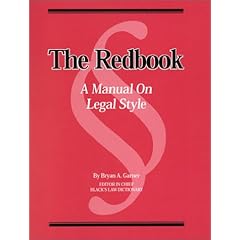
This is another book from Mr. Garner. My professor recommended this book for legal writing. It's lengthier and more complicated than the book I mentioned below. I just bought this book from Amazon.com.
Wednesday, December 27, 2006
A book for legal writing

Click here!
As an international student, I have difficulty in writing in English. Especially, it's a big burden to write a legal memorandum. Before I moved to Houston, one of my friends - U.S. lawyers - recommended a well-known book, "The Element of Style" by Strunk and White. But, the delemma I had was that that book was not for law students.
In Legal Analysis and Research class, my professor, Smith, recommended a book titled "The Redbook" by Mr. Garner, an editor of Black's Law Dictionary. While I searched that book in Amazon.com, I found his another book, "The Element of Legal Style, 2nd." In the introductionary section of this book, Mr. Garner stated this book would be another version of "The Element of Style" for LAW students and lawyers.
Yes! This is it. This is what I've been looking for.
Tuesday, December 26, 2006
A Brief history of the Bill of Rights
1791, the first ten amendments to the Constitution - religious liberty, free speech, personal privacy, private property, procedural fairness against the power of the democratic majority.
After Civil War (1861 ~ 1865), a second Bill of Rights (the Thirteenth, Fourteenth and Fifteenth amendments) - outlawing slavery, guaranteeing equal protection of the laws, assuring the right to vote to members of racial minorities.
1919, the Nineteenth Amemdment - women's right to vote
1970, the Twenty-fifth Amendment - right to vote for youths 18 and over
cf. For constitutional law, this site, Justice Learning, is so good!
Saturday, December 23, 2006
Kemah, Kemah
As a newcomer of Houston, I asked to my classmates which place would be good for my short trips during winter break. One of them recommended Kemah, a beach city adjacent to Houston. I got the visitor information from www.kemah.net


Kemah is a small and attractive place for half-day sightseeing.


I enjoyed nice views of Gulf of Maxico.


Friday, December 22, 2006
Museum of Fine Arts in Houston

Houston, as one of big cities in U.S.A., has a lot of advantages. One of them is to have many attractions like Museum of Fine Arts(MFA).
I've been to MFA today. One good news is that the admission is free on every Thursday.
The photo above is not taken in MFA. I took it in a sculpture garden in front of MFA.
It was so amazing to see the valuables from Aztec, Maya, Inca civilizations. I strongly recommend it to you.
Thursday, October 26, 2006
Law school ranking article from Posner
Click here!
It's quite fun that Richard Posner published a paper about Law school ranking. Surely, his law & economics viewpoints would be the basis of this article.
I didn't read it and will not read it, but it's funny.
It's quite fun that Richard Posner published a paper about Law school ranking. Surely, his law & economics viewpoints would be the basis of this article.
I didn't read it and will not read it, but it's funny.
Monday, October 16, 2006
Writing Tip - Parallelism
- Legal writing center provides `Writing Tip of Week` article, once in a week. This is one of my favorite e-mails in UHLC.
October 16, 2006
Writing Tip of the Week
Parallelism
1. Items in a series should be in parallel form to make a sentence easy to follow. Parallelism is achieved by joining words with similar words: nouns with nouns, adjectives with adjectives, adverbs with adverbs, prepositions (or prepositional phrases) with prepositions, and so forth.
The defense argued that the evidence was inconclusive, prejudicial, and irrelevant. (adjectives)
The defendant claims that on the day of the murder he was at home alone washing his car, mowing his lawn, and bathing his dog. (gerund phrases)
The witness told the police officer that the car rolled down the hill, over the lawn, and into the swimming pool. (prepositional phrases)
2. Use Parallel Structure With Coordinating Conjunctions. In general, use the same grammatical structure on both sides of any of the coordinating conjunctions—and, but, or, nor, so, yet.
Nonparallel Louise spent three years in Houston going to law school and clerked for a tax firm.
Parallel Louise spent three years in Houston going to law school and clerking for a tax firm.
3. Use Parallel Structure With Correlative Conjunctions. Use the same structure after both parts of a correlative conjunction—either . . . or, both . . . and, neither . . . nor, not . . . but, not only . . . but also, just as . . . so, whether . . . or.
Nonparallel I told my father that my intentions were either to study law or learning tenor saxophone.
Parallel I told my father that my intentions were either to study law or to learn to play tenor saxophone.
Nonparallel The purpose of the rule is to ensure that actual notice is provided either by personal or constructive service.
Parallel The purpose of the rule is to ensure that actual notice is provided either by personal or by constructive service. Or
Parallel The purpose of the rule is to ensure that actual notice is provided by either personal or constructive service.
Adapted from: St. Martin’s Handbook-- Lunsford and Connors
The Legal Writing Handbook-- Oates, Enquist, and Kunsch
Prepared by James Wright and Chris Dunn
Subscribe to:
Posts (Atom)